
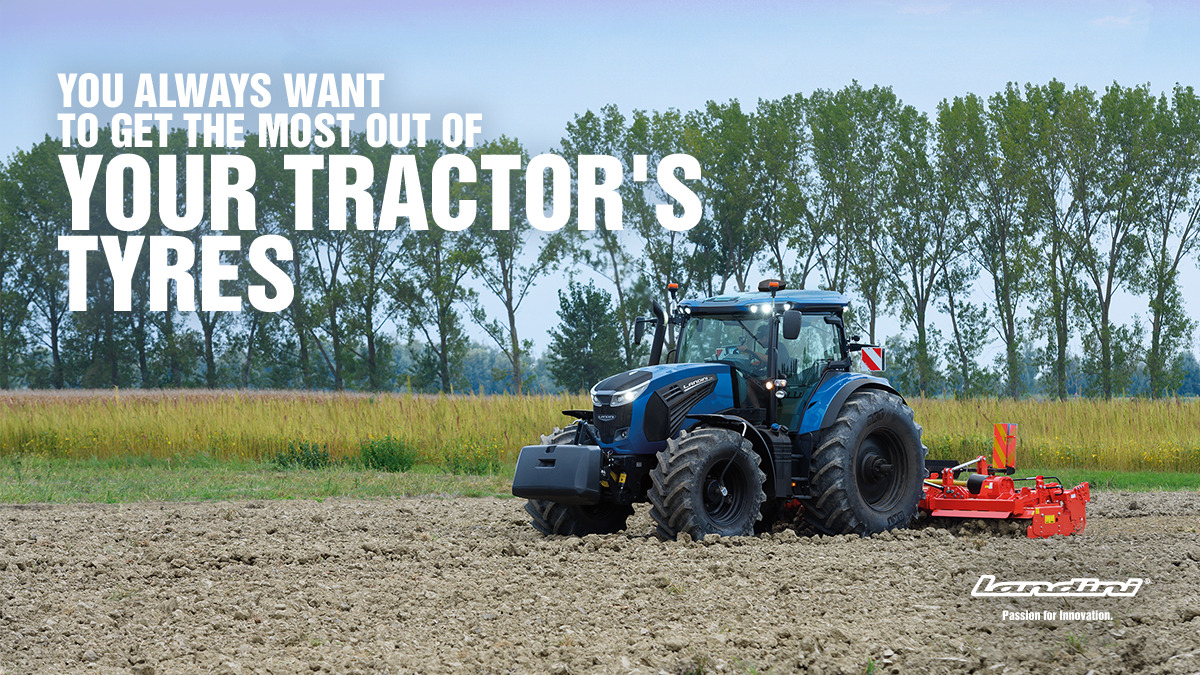
They’re an extremely important “accessory”
The same high levels of care and attention that we dedicate to our cars’ tyres must also be devoted to those on our tractors. Tractor tyre management is of fundamental importance, with all of the relative activities being aimed at optimising their use, maximising their lifespan, and reducing consumption as much as possible. In fact, the correct use of the machine and its tyres, combined with regular maintenance, can provide for significant savings.
Tractor tyre characteristics
The first distinctive characteristic of tractor tyres is their load capacity, which is directly proportional to their width. The load capacity is directly related to the volume of air contained in the tyre, so a greater size means the possibility of using larger and heavier implements. Another typical characteristic is offered by the Improved Flexion (IF) and Very High Flexion (VF) tyre types. These tyres differ from the others in that they have flexible sidewalls, which flex more under heavier loads, thus increasing the tyre’s footprint. This allows the weight of the machine and its implements to be better distributed, thus preventing excessive soil compaction. Finally, it is important to be aware of other fundamental elements, such as the tyre size indications. A series of numbers and letters are indicated on the tyre itself, for example “600/65R28”. The first number refers to the tyre width in millimetres. The second number refers to the sidewall height, as a percentage of the width. Finally, the letter R indicates that the tyre is a “Radial” tyre, and the number that follows represents the rim diameter in inches.